After VOOM, Build an Owned Content Hub — With the Rich Menu as Its Always-On Front Door

Updated: Aug 11

In 2026, LINE VOOM is being scaled back and shut down across several APAC markets — Thailand has announced a September discontinuation, Japan has confirmed a full shutdown, and Taiwan is seeing the feature weakened and its placement relocated. For many brands, this isn't just "one less place to post videos." It's the loss of a surface where content was browsed and discovered inside LINE.
And the most instinctive reaction has appeared: "Then let's just send more push messages to get our content out there." But that is exactly the move to avoid right now.
What Brands Actually Lose When VOOM Shuts Down
Brands never ran VOOM to "produce video." They ran it because they wanted a place inside the LINE ecosystem where members would proactively see the brand's content — new products, events, brand stories, member-only information. VOOM played the role of a content-discovery surface.
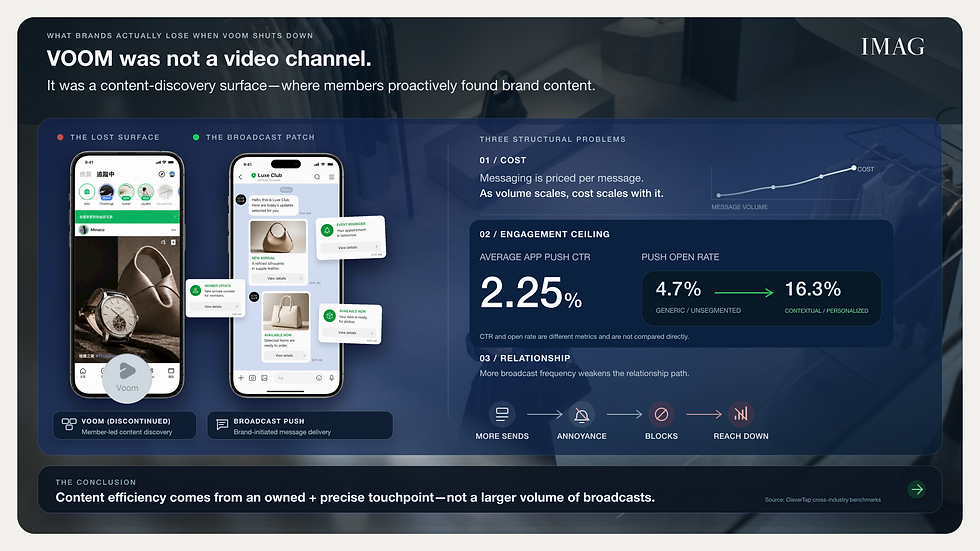
When that surface disappears, the gap is "how does content get seen by members." And patching that gap with push messages runs into three structural problems:
Cost: LINE Official Account messaging is priced per message. Using broadcasts to substitute for content exposure sends costs out of control as volume scales.
Ceiling: Push has an inherently low engagement ceiling. Globally, the average app push click-through rate is only about 2.25%; generic (un-segmented) push has an open rate of just 4.7%, and only contextual, personalized push reaches 16.3% (CleverTap cross-industry benchmarks). In other words, using "broadcast" to substitute for content is structurally inefficient.
Relationship: Raising frequency for the sake of exposure tends to buy you annoyance, blocks, and deteriorating reach.
These numbers point to a single conclusion: the efficiency of content marketing comes from an owned and precise touchpoint — not from a larger volume of broadcasts.
The Deeper Problem: Brands Have Been Renting Reach, Not Owning It
Go one level deeper, and what VOOM's exit exposes is a more fundamental dependency: a brand's content reach has long been borrowed.
VOOM's reach was decided by the platform's algorithm and product strategy — it can be granted, and, as we're seeing now, it can be taken back. When a brand builds its content on borrowed reach, one platform change breaks the whole thing.
The real question isn't "which placement replaces VOOM," but: does the brand have a content space it fully controls — one the platform can't reclaim?
The Two Parts of the Solution: Content Needs a Home, and the Home Needs a Door

To turn borrowed reach into owned reach, two parts have to be in place together:
First, content needs a permanent home — a Content Hub.
A Content Hub is a content center built inside the brand's own LINE OA, gathering new-product information, member-only content, wallpaper/asset collections, and saved content into one permanent page. Delivered as a LIFF, members can browse, save, and revisit it any time — content is no longer a push message that vanishes when scrolled past, but a space that accumulates and can be looked back on. This is what elevates content from a "one-off message" into an owned content asset.
Second, this home needs a door that's always visible — the Rich Menu.
No matter how good the Content Hub is, it's useless if members can't find the entrance. And the one interface on LINE OA that stays pinned to the bottom of the screen the moment a user opens the chat is the Rich Menu. Using it as the entrance to the Content Hub gives you three things push can never provide:
Always-on, zero exposure cost: The Rich Menu doesn't charge for each time it's seen. Every time a member opens your OA, it's there — persistent visibility that push can't buy at any price.
Fully owned, brand-controlled: What the placement looks like, where it links, which entrances it holds — all decided by the brand, not swayed by a platform algorithm.
Segmentable and personalizable: Through member tiering, different members can see different Rich Menus and content entrances — what a VIP sees and what a new follower sees can be completely different.
VOOM is someone else's feed, where you wait for the algorithm to allocate reach; the Rich Menu is the navigation bar of your own space — the step that turns content from "renting reach" into "building a house."
The Data Behind It: An Owned Content Hub Compounds the Relationship
"Put content into an owned hub" isn't theory — cross-market private-domain data has validated it repeatedly (the figures below are from the China / Xiaohongshu ecosystems, which differ from LINE, and serve as directional reference only):
In China, after brands moved content and transactions into their own mini-programs plus member operations, private-domain cases reached a 20% 30-day repurchase rate (Tencent Ads private-domain case sharing).
Xiaohongshu's private-domain surfaces show the same direction: group-chat users' repurchase rate is 2.5× the platform average (Jiemian); users who join a brand's fan group convert at 3× the rate of ordinary users, and top merchants reach a 32% average repurchase rate (Huxiu).
These ecosystems differ from LINE, so treat the numbers as directional; but they point to one shared truth: once content has a home members proactively revisit, and interactions are deposited as member data, repurchase and conversion compound with the relationship — instead of resetting to zero with every push. The same logic is visible inside LINE — when brands shift LINE OA from a broadcast tool to segmented operations, open rates can climb from around 30% to over 50% (Crescendo Lab published client cases). Rich Menu + Content Hub is precisely how you build that "home" and "door" on LINE.
IMAG Relationship Operating System: Once Content Has a Home, the Relationship Can Stay

But one thing has to be clear: Rich Menu plus Content Hub solves "content getting seen" — which is not the same as "the relationship being cultivated." The entrance and the content hub are the necessary foundation; what gives them long-term value is the relationship logic they carry underneath.
This is exactly what IMAG's Relationship Operating System is built to answer: every tool — Content Hub, Rich Menu, push — is not the goal, but exists to cultivate the relationship. Under this system, the Content Hub isn't just a content page; it's a deposit point for relationship data:
Which category of content a member tapped, what they saved, how many times they returned — these interactions are all recorded as tierable member data.
Content interaction is no longer an exposure number, but a signal of "what this member is interested in right now, and where they are in the relationship."
The Rich Menu segments accordingly, delivering the right content to the right member — forming a loop of "content → interaction → relationship data → more precise content."
Within IMAG's Relationship Operating System, the Content Hub, the RSVP system, and the membership system are three landing modules. Building a Content Hub after VOOM's exit isn't swapping in a new content placement — it's connecting brand content into a system that accumulates relationships. That's the real meaning of "owned": not just owned placement, but owned relationships.
What Brands Can Check First
Before rushing to find "a replacement placement for VOOM," run this quick self-check:
Does our content have a home members can enter any time, that's always there, and can be revisited — rather than scattered across individual push messages?
When a member opens our LINE OA, does the first Rich Menu they see guide them to content, or only to customer service and campaign links?
Do members in different tiers see the same Rich Menu and content entrances, or segmented ones?
Are members' content interactions (browsing, saving, revisiting) written back to member data, or do they vanish once viewed?
If you can't answer two or more of these, then VOOM's exit is actually a moment to upgrade content from "borrowed exposure" to "an owned asset" — not a hole to patch.
Next Step
If you're facing the "VOOM is gone and I don't know where content should live" situation, start with a LINE OA Health Check: audit your current Rich Menu configuration and content touchpoints, find where the gap sits between a "one-off push" and an "always-on Content Hub entrance," and from there design an owned content architecture that deposits content interactions as relationship data.
About IMAG
IMAG is a specialist in private-domain strategy and data integration, helping brands build long-term relationships with consumers in owned channels and design complete user journeys — with deep expertise in using data to cultivate brand relationships at every step of the consumer journey. Book a consultation with us.
IMAG Website: www.imag.global
Contact Us: info@imagtw.com
Author: Gilbert Fang, Deputy General Manager, IMAG Marketing


Comments